Posts

Showing posts with the label training

Beyond "Just Do It More": Breaking Through Athletic Plateaus

  If you want to run faster, you just need to sprint more. If you want to jump higher, you just need to jump more. And if you want to slide faster defensively, you simply need to slide more. It sounds clean, intuitive, and beautifully simple. But while this philosophy holds a core truth, it only tells half the story. This mindset relies on the Law of Specificity , or the SAID Principle (Specific Adaptations to Imposed Demands) . This physiological rule dictates that the body adapts precisely to the movement, velocity, and energy system to which it is subjected. If your goal is elite speed, the brain must practice firing muscle fibers at maximum velocity. You cannot jog your way to explosive speed. However, relying exclusively on this rule will eventually lead to a frustrating, unyielding performance plateau. Here is how to reconcile the need for specific skill practice with the physical requirements for true athletic advancement. Where the "Just Do It" Philosophy Succeeds: Sk...

Eliminating Kinetic Leaks: The Blueprint for Elite Lateral Speed and Defensive Agility

  When an athlete looks slow moving sideways on the court, coaches often attribute it to a lack of effort or poor raw conditioning. More often than not, the real culprit isn't a lack of engine power—it is a geometric failure. To unlock elite lateral sliding speed and razor-sharp defensive changes of direction, you have to eliminate force "leaks" along the kinetic chain. The kinetic chain is the coordinated pathway through which force travels from the ground, up through the body, and into the athletic movement. When a player steps out with the wrong foot first, stands too upright, or pushes from an inefficient part of the foot, force dissipates instead of driving them sideways. Great lateral velocity is never built by reaching for space with your lead leg; it is generated by aggressively pushing the floor away with your trailing leg. The following targeted technical drills are designed to clean up structural footwork errors, correct positioning leaks, and maximize absolute...

Building the Complete Athlete: Mechanics, Progression, and Court Transfer

 In our last discussion, we broke down the myth of the "Force Ceiling" and established that sport-specific practice must be backed by targeted structural strength. But understanding the theory is only step one. How do you actually implement these concepts on the floor? To move an athlete from a theoretical framework to elite performance, we have to master three distinct practical disciplines: sharp-shooting body mechanics, safely implementing high-velocity training for developing bodies, and transferring dry-land speed into chaotic, reactive sports environments. Here is your deep-dive blueprint for all three. 1. Fixing Shin Angles: Creating Lateral Power Instead of Reaching When an athlete looks "slow" moving laterally, coaches often scream at them to try harder or move their feet faster. More often than not, the issue isn't effort—it's geometry. When a player reaches for space with their lead foot, their shin stays vertical or tilts inward. This forces them...

The Athletic Myth: Why Just “Doing It More” Hits a Hard Ceiling

If you want to run faster, you just need to sprint more. If you want to jump higher, you just need to jump more. And if you want to slide faster defensively on the court, you simply need to slide more. It sounds clean, intuitive, and beautifully simple. But is it actually true? The short answer is yes —but it only tells half the story. What this mindset describes is a foundational law of sports science: The Law of Specificity , also known as the SAID Principle ( Specific Adaptations to Imposed Demands ). This physiological rule dictates that your body adapts precisely to the exact movement, velocity, and energy system you subject it to. If your goal is an elite sprint time, your brain has to practice firing muscle fibers at absolute maximum velocity. You cannot jog your way to explosive speed. However, relying exclusively on this rule to build an athlete will eventually lead to a frustrating, unyielding performance plateau. Here is a look at where the "just do it more" philo...

Player Development Overview

One of my favorite parts of coaching is the actual development of players.  In the many years I have spent coaching, I have had the pleasure to coach kids who were willing to put in the work and who saw benefits from it.  My job as skills coach is to keep the players improving.  We have spoken before about getting players to go beyond their comfort zone into an area of the unknown. An area that may seem awkward to them at the beginning but with constant reps will get easier and more instinctive. The area of unknown has to be very carefully determined.  The area identified can't be too difficult for the kids to perform or else they can get discouraged.  On the other hand, the area can't be too easy as to not challenge the kids.  In order to do this properly there is a sequence that needs to be followed.  The sequence is challenge, evaluate, adjust, execute, and repetition. The first step of the sequence is to challenge.  Set up some basic drills th...

Layups, Layups, Layups

Image
 When we go to youth games we like watching how the kids warm up.  To us youth basketball is an easy game to coach.  As a youth coach you need to teach your kids how to play good aggressive man to man defense and on the offensive end teach them how to pass and move towards the basket.  In a pass an move offense, layups are so important.  This goes back to our opening statement about watching youth level warm ups.  Most of the teams warming up spend a lot of time shooting shots, but the good ones are always working around the basket.  We've always found it entertaining that youth teams spend so much time working on jumpers and so little time on layups.  In addition, the little time they do spend on layups is spent doing basic layups using the right hand on the right side and the left hand on the left side.  There is so much more to it than this however and kids should be exposed to different types of layups in practice.  No one can predic...

Article: Imrpoving your Vertical Jumping Training

Click on this link for another nice article on vertical jump training. I'm convinced that this workout not only helps your vertical jump but will help you improve your sprint speed as well.

Article: Vertical Jump Training

If found this interesting blog post in www.hoopsbeast.com talking about how to increase your vertical jump.  Click here to read.

Improving Your Footspeed

I've been coaching youth basketball for many years and the one thing that I've seen is that some kids naturally know how to run while others are so inefficient in their running style that you can't help but wonder how much better they would be if they simply worked on their running form.  The purpose of this post is to help kids improve their running form and thus help increase their foot speed. Problems with Inefficient Runners Relax - The main problem that I see with most kids who seem to run slower than they should is that they tense up.  The main key to running is that you stay relaxed.  You need to stay relaxed in the face, the shoulders, the arms, the hands, and you hips.  Tightness in any of these areas can cause you to run slower than you are capable of. Foot Strike - Many kids are plodders.  They run by slamming their feet on the ground instead of focusing on being light on their feet.  Their heels make great contact with the ground and this serves as a brake...

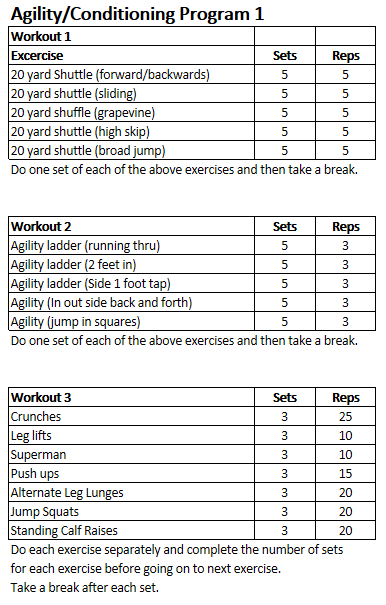
Offseason Conditioning: Agilitily and Conditioning for Beginners

Image
In an effort to kick-start our offseason conditioning we are including the first of 3 agility/conditioning programs we encourage players to follow.  Here are the instructions to follow when doing these programs:

An Introduction to Cuts

Image
One of our mottoes here at That Basket Life is take nothing for granted.  This is why we spend a lot of time covering topics like pivots, and close-outs and all sorts of topics related to footwork and screening.  They may be boring on the surface but if you master the details you will become a better more efficient basketball player.  In this post's discussion we are covering another one of these boring yet important topics.  Specifically, we will be discussing some of the more popular cuts involved in basketball.  Cuts are very important in basketball.  So important that in order to stand a chance to challenge a defense, any offense should have at least some sort of cutting action in it. Some of the cuts we'll be covering below are: Basic Cut V-Cut L-Cut Flash Cut Backdoor Cut Curl Cut Loop Cut UCLA Cut Flare Cut Laker Cut

Jump Stops

Image
Below is a great video on the jump stop.  The jump stop one of the most powerful moves in basketball.  It combines power and control especially in the paint.  I will have a whole article on the beauty of the jump stop soon but for now this is a nice video.

Increase Agility Using Iowa State’s Cone Shuffles!

Image

Cool Video on How to Jump Higher

Image

Shooting Drills for Post Play

Below is a nice sequence of shots to follow that you can practice in order to improve your game around the rim.  Keep in mind that this sequence should not be ignored by perimeter players.  It should be followed by all basketball players who want to improve their game.  In today's game everyone seems to love the long range shot and few people are efficient at finishing from closer to the basket.

Shooting drill

This is a great sequence to follow in order to help with your shooting during the off season. The following sequence will not only help your shooting but will also help to improve your conditioning as it is non stop shooting for a good half hour. Mikans-both hands both sides 10 shots each side Mikans-hook shot both sides 10 shots each side Mikans-reverse shot both sides 10 shots each side Lay ups - 10 shots each side Lay ups - inside hand 10 shots each hand Lay ups - reverse with strong hand both sides 10 shots Lay ups - reverse with weak hand both sides 10 shots Lay ups - from right side straight up the middle shoot with left hand 10 shots Lay ups - from left side straight up the middle shoot with right hand 10 shots Floater - from right side up the middle shoot with left hand 10 shots Floater - from left side up the middle shoot with right hand 10 shots Free throws - 10 shots Around the world - 5 feet away from 5 different spots keep shooting until you ...

Level 8 Ball Handling

Image

Level 7 Ball handling

Image

Layer 6 Ball Handling

Image

Level 5 Ball Handling

Image